skip to main |
skip to sidebar
While hanging in there at the busy Royal Highland Show I found a review by P.D.James which helped me to understand Calvino's famous book, "Invisible Cities".
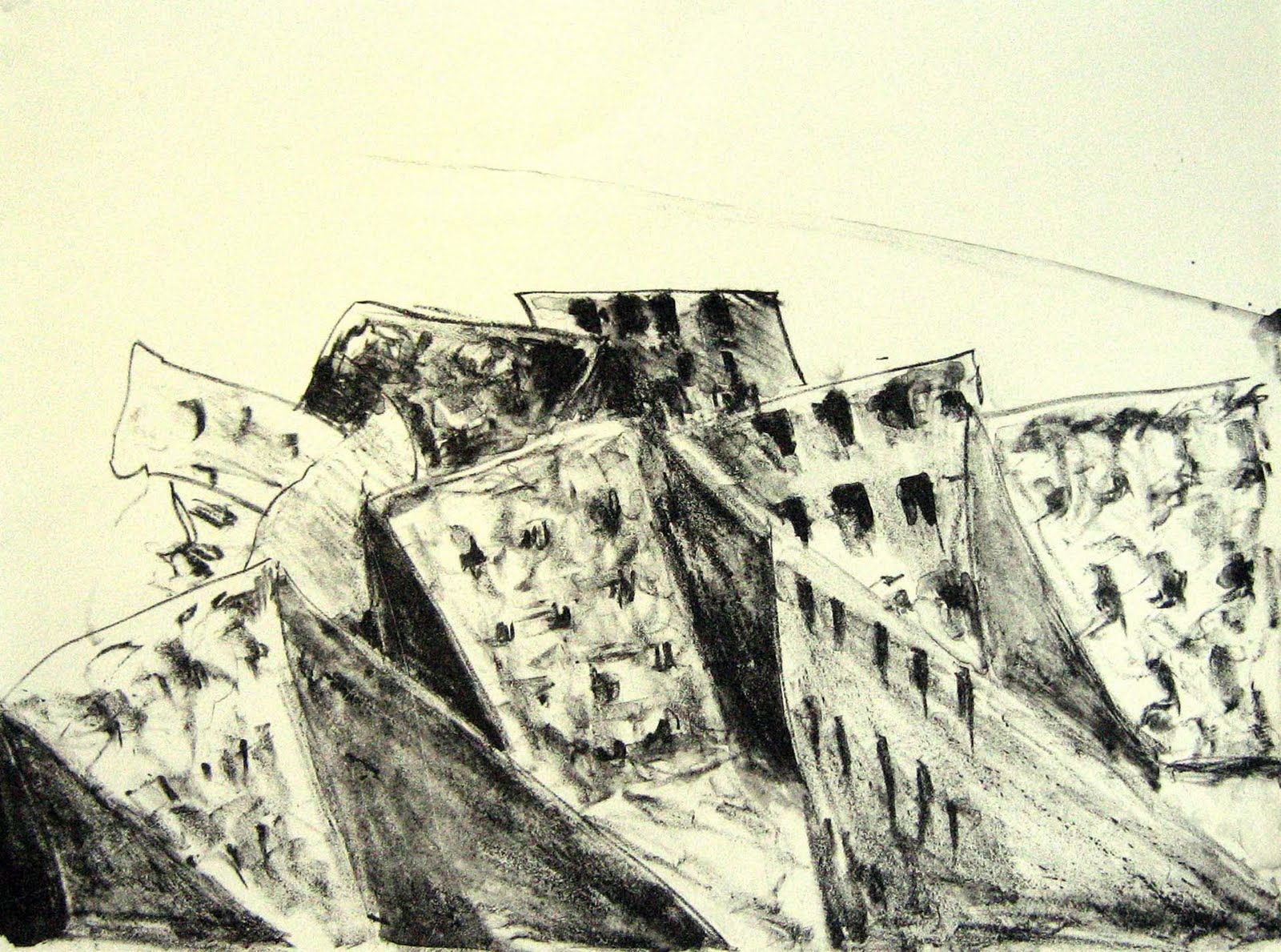
She writes: "Marco Polo, the narrator of Italo Calvino's Invisible Cities, does not attempt to describe the city of Zaira by simply listing the number of steps in its streets that rise like stairways, or the precise type of zinc tiles used on its roofs. He knows that mere facts alone are not sufficient. For Zaira, like all great cities, consists of "relationships between the measurements of its space and the events of its past". Monuments, city squares, even street names are dense with memories and recollections: the city is a place of living history, a mashup of past and present." www.guardian.co.uk search for "Boulevards of dreams" (26.6.10). Diana Hand "The destroyed place" lithograph
I have owned a copy of this book for many years and always found it impenetrable. Looking on-line I am not the only one. I feel I know exactly what he is writing about but I cannot quite "get" it, which is frustrating, particularly as my drawings and prints are about this. But now I am a step nearer. I am reading a chapter a day... most days.

When I was in London briefly a couple of weeks ago (en route to Portugal) I saw this interesting exhibition by Barbara Rae, the Scottish painter and printmaker. I was inspired by her use of overlays of translucent colour. She uses a monotype method, which I willl study. The dyes that I use on fabric are very good for translucency, which is probably why I like them so much, but I do not know what medium would be as good on paper. Watercolour is almost too translucent.
I have been away this month, first to Portugal for a riding holidayhttp://www.flickr.com/photos/43943835@N08/and then to a Highland retreat for a great tai chi experience. I have met lots of people and had a good time. Now back to the studio.
I am preparing for my Open Studios event. My holidays, particularly the tai chi week, helped me to get this into perspective. I will be showing some work-in-progress, an honest account of where I am at (if possible). I have planned it carefully, and decided to pin drawings and prints up on large sheets of polystyrene. This looks fine and is a lot cheaper and simpler that mounting and framing work. I will write some info to explain my ideas and have some books for people to look at.
It is great to have this opportunity of focussing on and displaying what I am doing. Thanks to all the hard work by organisers of Forth Valley Open Studios, www.forthvalleyopenstudios.com.

I am reading a book about equine anatomy. Excellent book, encourages free experiment with different media and a relaxed approach. I am doing this because I have always enjoyed drawing horses, and because I want to make some drawings, paintings and prints for my stand at the Royal Highland Agricultural show at the end of June.
At one point in t his book, however, the author writes that even if someone has a facility for doing drawings (or anything), unless he or she has some underlying knowledge (about anatomy in this case) there is little scope for developing the work. One is always restricted to repeating the same theme.
Brilliant! I have experienced this state. I am good at playing with colour on fabric but after years of success I did not know how to move forward. Therefore I took the radical step of enrolling for a degree at Glasgow School of Art in 1997. A huge adventure full of the totally unexpected. Only now am I integrating this experience more deeply into my practice. I tremble as I write this, it is a vulnerable area.
A new thought - when making things, using hands, body and materials, it is important to practice constantly, I find. Otherwise flow, rhythm and ease are lost. But with ideas, it is different. Once established or "planted" they have an independent existence, and benefit from not being over worked. What an interesting difference!


 n shone, my marquee was perfect, I was able to set up my own "solo" exhibition, I had lots of visitors .. and an American friend, Elliott, made delicious cakes. What's not to like?